Two Teams, One Pitch: The Saturday League Quietly Winning Over Our Teenagers
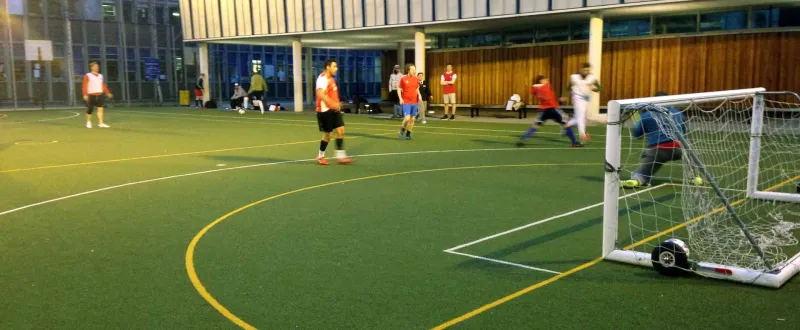
Photo: teenagers playing five-a-side football on a wet park pitch UK, via blog.playo.co
By half nine on a Saturday morning, the changing rooms at the park off Pelham Road are already humming. Boots are being laced, bibs argued over, and a group of fourteen-year-olds who live four streets apart — but might as well live in different worlds — are discussing defensive formations with the seriousness of Premier League professionals.
This is the Al-Baraca five-a-side league, and it costs us roughly the price of a bag of oranges per week to run.
How It Started
The league began three years ago with a simple complaint: there was nothing for the older lads. Not structured academy football, not pay-per-session coaching — just somewhere to play, regularly, with proper organisation.
Two volunteers, both dads from the association, marked out pitches, drew up fixtures and set one rule above all others: teams would be mixed deliberately. Nobody plays only with their own postcode.
"First season, they sulked about it," says coach Imran, who has run the fixture list since the beginning. "By Christmas, they were asking to swap bibs so they could stay with lads from the other estate. That's when we knew we had something."
A Season in Miniature
We followed the 2024–25 season from that first cold kickoff in September. Twelve teams, ages thirteen to seventeen, two divisions. Attendance held above eighty per cent all winter — a figure youth services in the borough told us they'd consider remarkable for any provision, let alone one run on donations and goodwill.
The fixture list survived a flooded pitch, a stolen goal net and one memorable week when a referee didn't turn up and a seventeen-year-old named Dawa took charge of his own match. "He was surprisingly fair," Imran notes. "The parents disagreed. Loudly."
The cup final, played in April under a sky that couldn't decide whether to rain, ended four-three after a shootout. The trophy was a repurposed rose bowl donated by a grandmother on the committee. It has already been dropped twice.
What the Players Say
Ask the teenagers themselves and the answers are refreshingly unsentimental. "I just like that it's free and it's every week," says Yusuf, fifteen. "You know where you're going on a Saturday."
But the subtext emerges in longer conversations. Several players mention that the league is the only place they regularly spend time with lads from the opposite side of the ward. One parent, Amina, puts it plainly: "My son used to be home with a phone in his hand all weekend. Now he's out, he's tired on Saturday evenings, and he talks about people whose mums I've actually met."
A local PCSO who attends most weeks was blunter still: "Anti-social behaviour reports around the park drop noticeably on league Saturdays. I'm not claiming causation, but I'm not ignoring it either."
Why Cheap Beats Expensive
Borough youth provision is not short of funding proposals — short-term projects with branding, outcome frameworks and equipment budgets that would make our league weep. Yet provision is patchy, sessions get cut when grants end, and the young people most in need of stability are the first to lose it.
Our league works, we'd argue, because of what it lacks. No referral process, no eligibility criteria, no six-week funded pilot with an exit strategy. Just a fixed time, a familiar place, and adults who turn up. Consistency, it turns out, is the intervention.
The total annual cost — balls, bibs, first aid kit, hot drinks — comes to less than many schemes spend on a single launch event.
What's Next
September will bring a girls' division, requested loudly and repeatedly by younger sisters who have been watching from the touchline for three years. We're also seeking two more volunteer referees, which is the least glamorous and most urgent recruitment drive in the organisation.
If you can give up two hours on a Saturday — to referee, to run the tea urn, or simply to make sure every child gets a bib — the league will still be there, and so will the lads. Some things, it turns out, are best organised cheaply and kept forever.