Dominoes, Dhal and the Art of Listening: Inside the Back Room Where Our Men Learned to Open Up
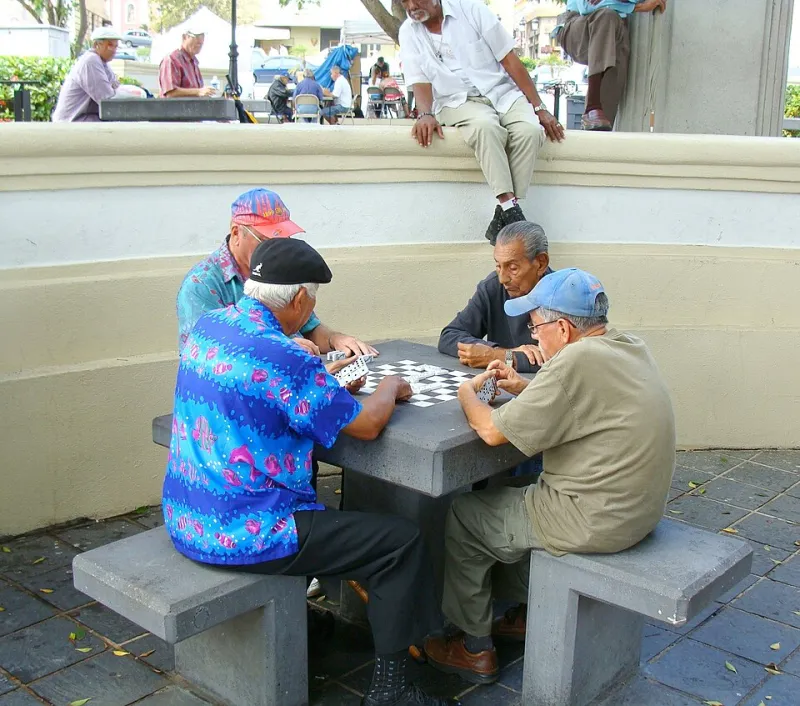
Photo: Tomás Del Coro, CC BY-SA 2.0, via Wikimedia Commons
A Sign on the Door
For a long time, the noticeboard outside the back room carried a single sheet of A4. It read, in careful lettering: Men's Wellbeing Circle — Everyone Welcome. Attendance was thin. A handful of familiar faces, a lot of polite head-nodding, and a room that emptied by eight o'clock.
Then someone took the sign down.
What replaced it was simpler still: Dominoes Night — All Men Welcome. The change seemed trivial at the time, almost an afterthought ahead of a refurbishment. Eighteen months later, we can say plainly that it was the most important piece of editing this association has ever done.
Why the Word 'Wellbeing' Cleared the Room
There is a particular kind of hesitancy that many men in our community carry when it comes to their own struggles. It cuts across generations and backgrounds — the builders and the taxi drivers, the recent arrivals and the families who have lived on these streets for four generations. Asking for help, particularly for anything touching on mental health, can feel like an admission of failure, or worse, an act of disloyalty to the family.
The statistics back up what we see anecdotally. Suicide remains the leading cause of death for men under fifty in the UK, and men are consistently less likely than women to access talking therapies. Within some cultural and faith communities, the barriers are compounded: a fear of being judged, a worry that difficulties will be whispered about, and a genuine uncertainty about whether seeking support conflicts with notions of patience and resilience.
Our answer was not to argue with any of that. It was to stop labelling the thing altogether.
What Actually Happens on the Night
The group meets on the first Wednesday of each month, from seven until half nine. There is no agenda taped to the wall and no facilitator with a clipboard. There is a folding table, a battered dominoes set that has survived two decades of enthusiastic play, and a rotating roster of volunteers who bring food — a lamb curry one month, chicken and rice the next, always far too much of it.
The first hour is, to any observer, just a games night. Men arrive, greet one another, argue amiably about a disputed six-three. Tea is poured. The room hums.
The shift happens gradually. Someone mentions a redundancy. Someone else, without fanfare, mentions a sleepless stretch, or an argument at home, or the weight of a parent's diagnosis. Nobody announces a topic. Nobody puts anyone on the spot. The dominoes continue to click, and somehow, because hands are busy and eyes are on the tiles rather than on the speaker, the difficult things get said.
The Night That Made the Case
We will not name him, out of respect, but one regular attendee has given us permission to describe what happened last autumn — because we believe it matters.
A man in his forties, self-employed and recently separated, had been coming along for a few months. He spoke little. He played dominoes badly, cheerfully, and drank his tea. One Wednesday, after the others had drifted out, he lingered by the door and told a volunteer that he had been standing on a bridge on his drive home from a job the previous week, and that what had stopped him was thinking about who would take the rest of the rice if he didn't turn up on Wednesday.
He laughed when he said it. The volunteer did not. Within the fortnight, he had been connected with his GP and a local counselling service — through signposting we could offer precisely because he had, over months of dominoes, learned that the people in that room were safe.
He still comes. He still loses at dominoes. He is, by his own account, in a different place.
Not Therapy, and Not Trying to Be
We are careful about what we claim. This is not a clinical service, and the volunteers who run it are not counsellors. What the group offers is something the NHS, for all its strengths, cannot: an informal, low-stakes threshold. It is a place where a man can practise talking before he ever books an appointment, and where the practical signposting — to a GP, to a debt adviser, to bereavement support — happens over a shared plate rather than across a desk.
We work alongside professionals, not instead of them. Several local services now send us their leaflets, knowing that a leaflet handed over at the right moment, by the right person, in the right room, is worth more than a hundred posted through doors.
An Open Invitation
If you are a man reading this and something in it has registered — for yourself, or for a brother, a father, a son, a neighbour — the door is genuinely open. First Wednesday of the month, seven o'clock, back room at the Al-Baraca Community Association. No booking, no fee, no expectation that you say anything at all on your first visit. Plenty have come for three months and only spoken in the fourth.
Bring nothing. Eat plenty. The dominoes will be waiting.